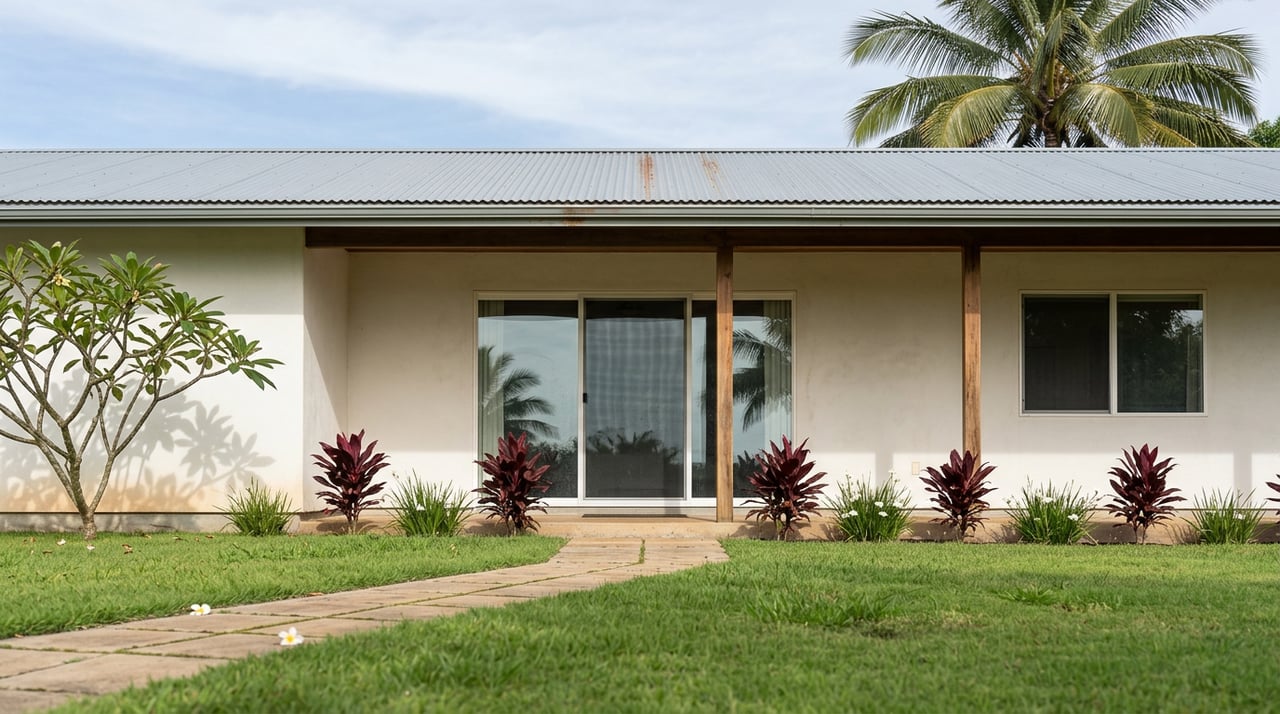
Ask anyone in Wailua what's happening at the old Coco Palms site, and you'll get some version of the same answer: a shrug, then a recitation of every date that's come and gone since the property started collecting promises instead of guests. The dust screens have been up since early 2023. Behind them, all you can see from Kuhio Highway are the tops of a few excavators and cranes, moving against a skyline of concrete shells nobody has finished tearing down or building up.
That reflex to disbelieve is earned. But something changed in June that's genuinely different from the last three times this story made the rounds, and it's worth separating from the noise, because most of what gets written about Coco Palms is about press releases and renderings. What actually shows up on the highway this year is a shorter, more useful story.
The Promises So Far
Coco Palms has been "coming back" in some form since 2016, when a Honolulu partnership called Coco Palms Hui first floated a Hyatt-branded reopening. Here's the pattern, stripped down to what was announced and what actually followed.
| When | What Was Announced | What Actually Happened |
|---|---|---|
| 2016 | Hyatt Unbound Collection reopening, via Coco Palms Hui | Project collapsed in 2019 |
| October 2023 | Reef Capital tells a community meeting it will finish demolition by year's end, start construction in early 2024, and complete the resort by the end of 2026 | Demolition dragged into 2024 and no vertical construction ever began on that schedule |
| June 2024 | Kimpton and IHG Hotels & Resorts announce a branded partnership, still targeting a 2026 opening | By April 2026, Reef Capital publicly abandons the 2026 date |
| June 2026 | X-Caliber closes $431 million in construction financing | New target is 2028, with major above-ground construction not starting until early 2027 |
Four resets in a decade, on a 32-acre property that's sat across from Wailua Bay in ruins since Hurricane Iniki tore through in September 1992. If you've lived here through even two of those resets, treating the next date with suspicion isn't cynicism. It's pattern recognition.
What $431 Million Actually Bought In June
The financing that closed on June 22 is real, and it's structurally different from anything attached to this property before. X-Caliber, a commercial real estate lender, arranged $185.6 million in conventional senior-secured financing plus $245.35 million through its CastleGreen Finance affiliate under a program called Commercial Property Assessed Clean Energy, or C-PACE. Together that covers roughly 80 percent of the project's cost, which the Garden Island reported at $539 million for the full build.
C-PACE financing is worth understanding because it's an unusual tool for a hotel project. It's repaid through an assessment on the property's tax bill rather than a conventional loan payment, which means the debt travels with the land itself rather than with Reef Capital Partners as a borrower. Mason Chock, an I Ola Wailuanui board member and former county council member, has argued that this specific financing structure requires county approval that hasn't been granted. Gary Hooser, a former state senator who lives near the site, called the announcement "hype" in The Garden Island. He also said, "If anyone believes that someone's going to give Reef half a billion dollars, I've got a bridge I want to sell."
Jon Day, Reef Capital's chief financial officer, has pushed back on the idea that nothing has moved. In Civil Beat, Day said, "I sometimes get frustrated when critics say nothing has happened on the site," and added, "Those concrete structures didn't demolish and recycle themselves. But I understand that people are excited for the vertical construction, and I am too."
Both things can be true. The money is the largest and most concrete commitment this property has seen in 33 years. It has not yet translated into a hotel, or even a foundation.
What Changes On Kuhio Highway This Year
This is the part that matters if you drive past the site on your way to Kapaa or Lihue. Based on Reef Capital's statements to Civil Beat, here's what's expected to be visible between now and the end of 2026:
- The developer is soliciting bids to demolish the old wooden retail building that still fronts Kuhio Highway
- Work is expected to begin on installing utilities and restoring the underground parking garages, which sit below the footprint of the original resort
- Day told Civil Beat that residents can expect to see a couple dozen workers on site starting in late summer or early fall of this year, which is roughly where the calendar sits right now
- Major, above-ground construction is not slated to begin until early 2027
So if you've noticed a few more trucks behind the fence recently, that tracks. What you won't see this year is steel going up, a pool being poured, or anything resembling the renderings that have circulated since the Kimpton announcement. The gap between "financing closed" and "you can see a building" is still measured in months of underground work, not weeks.
The Fight The Financing Didn't Settle
Money doesn't resolve a permit dispute, and this one is unresolved. According to Travel Weekly, Kauai County has confirmed that four permits were approved allowing construction on some of the resort's buildings, but permits for several other structures have expired. A county spokesperson said that if the developer wants to restart work on those, new applications are required and the plans would need to comply with current code. Day has described the outstanding items as administrative amendments to incorporate design changes invisible to a future hotel guest. Those two positions haven't converged.
The cultural stakes are also unresolved. Coco Palms sits on land tied to Deborah Kapule, Kauai's last queen, and the property is listed on both the National Register of Historic Places and the Hawaii Register of Historic Places. Ka Wai Ola reported that during construction of the resort's original north wing in 1973, 34 sets of iwi, or human remains, were unearthed, with some accounts suggesting the total from earlier construction phases may have been closer to 81. The report also says I Ola Wailuanui, the nonprofit that's spent years pushing for the site to become a cultural and educational center instead of a hotel, sent the county a letter this spring asking that the construction permits be revoked, citing ongoing legal disputes tied to the project. The Kauai Planning Commission rejected that petition.
There's also a political layer that's specific to this year. Kauai's 2026 mayoral race is underway, with former Mayor Bernard Carvalho and current Council Chair Mel Rapozo as the leading candidates and Council Member Felicia Cowden also in the race. Coco Palms hasn't become a defining campaign issue, but residents who've followed the saga will likely be watching for where each one lands.
None of this is new tension. What's new is that, for the first time, there's enough capital behind the project that the tension has somewhere real to attach itself. Reef Capital's plans call for reviving three of the original resort's dining rooms under their old names, the Lotus, the Flame, and the Seashell, along with a 300-seat cultural center developed with guidance from a Coco Palms Cultural Advisory Committee. Whether that materializes on the same site as active opposition and unresolved permits is the open question the financing didn't answer.
The Honest Answer
If someone asks you this year whether Coco Palms is actually happening, the accurate answer is more specific than yes or no. The money closed in June, which is a first. A couple dozen workers should be visible behind the fence by fall, doing utility and demolition work most drivers won't notice from the highway. Nothing resembling a hotel will be visible until construction crews start pouring foundations, which isn't expected before early 2027. And the permit questions, the cultural objections, and the county election all sit underneath the financing announcement, unresolved by it.
That's a different story than "Coco Palms is back," and it's also different from "Coco Palms is dead." It's the most honest version of where things actually stand on a property that's tested Wailua's patience for over three decades.
If you're weighing what a project like this means for a specific property, a street, or a plan to buy or sell in Wailua, that's a conversation worth having directly. Michael Ambrose tracks these local shifts as part of daily work on Kauai's East Side. Call or text anytime to talk through what's actually happening in your corner of the island.
This article is general information, not legal, tax or financial advice. Consult a qualified professional about your situation.